- The 17 teams developed working prototypes during a 48-hour challenge held at the Robotory from 23 to 25 October
- The winning projects explore industrial applications, household tasks and robotic chess, sharing a total prize fund of €3,000
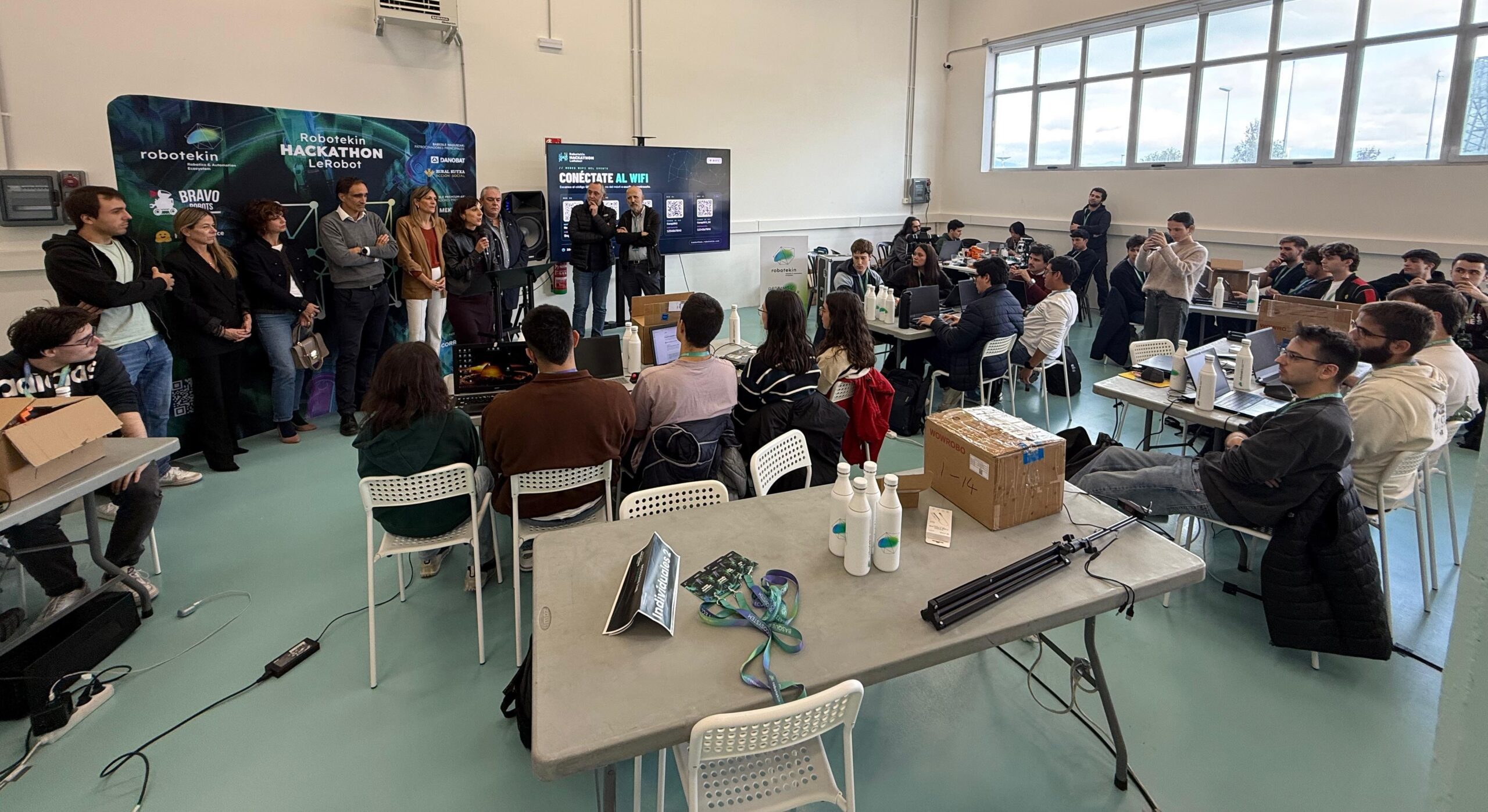
A total of 66 young people aged 18 to 35 took part this weekend in the first Robotekin LeRobot Hackathon. Working in 17 teams, they tackled a 48-hour challenge: teaching robots to perform tasks autonomously by learning from human demonstrations, using artificial intelligence and open-source tools.
Organised by Robotekin, the Basque Association of Robotics and Automation, in collaboration with Bravo Robots, the event brought together students, researchers and young industry professionals at the Robotory, the association’s headquarters. Teams were able to experiment with real robotic arms and present working prototypes at the end of the competition.
Three winning projects with very different applications
The €1,500 first prize went to MSN, a team of three students from the University of Málaga. They developed a robot capable of precisely illuminating a point marked by a welding operator. The system could adapt its movement when faced with an obstacle and find another angle from which to keep the designated point illuminated, offering a way to make work easier in an industrial setting.
MURobot, a five-member team of students and doctoral researchers from Mondragon Unibertsitatea, won the €900 second prize. The team worked with an OpenArm from Enactic, a dual-arm robot larger than those used by the other participants. They trained it through imitation learning to perform household tasks, such as cleaning a plate or taking out a slice of toast. The project used an external motion capture system to transfer human demonstrations to the robot.
The €600 third prize went to Law Le Baguette, a team of four students from the University of the Basque Country’s Vitoria-Gasteiz School of Engineering. Their project focused on a robot capable of playing chess against a person. The challenge required combining different techniques to respond to the wide range of moves and situations that can arise during a game.
Practical experience of applying artificial intelligence to robotics
During the hackathon, teams used LeRobot, the open-source robotics platform developed by Hugging Face. This technology allows human demonstrations to be recorded and used to train AI models that then perform tasks through a robot. Participants worked through the different stages of the process, from collecting data to testing and refining their prototypes.
Bravo Robots provided 17 SO-101 robotic arm kits, cameras and tripods. Throughout the weekend, participants also received support from mentors, who helped them overcome technical difficulties and make progress with their projects.
The experience introduced participants to physical AI: artificial intelligence applied to systems that act on their surroundings. Working with real robots allowed them to experiment with imitation learning and discover the challenges involved in translating a human demonstration into an autonomously performed task.
Connecting young talent with companies
The event attracted 79 registrations, with 66 people ultimately taking part, including nine women. Participants came from the Basque Country, Navarre, Cantabria, Madrid, Andalusia, Catalonia, La Rioja, Castile and León, and Castilla-La Mancha.
Participants included representatives from the University of the Basque Country, the University of Deusto and Mondragon Unibertsitatea, alongside young people already working in industry. One team, for example, comprised four professionals from Rubí Automotive, a Robotekin member company. Bringing these different backgrounds together encouraged knowledge sharing between academia and business.
“Participants were able to experience first-hand how a robot is trained and what it takes to turn an idea into a working solution. Bringing students, young professionals and mentors together allows them to share knowledge and connect that learning with companies’ needs. At Robotekin, we want these events to inspire career interests and create new connections between young talent and our ecosystem,” said Leire Balzategui, Director General of Robotekin.
With this first edition, Robotekin strengthens its work to bring robotics and automation closer to younger generations and connect talent with companies in the Basque ecosystem. The hackathon provides a practical setting in which to explore technologies such as physical AI and share experience with industry professionals.
The initiative was sponsored by Robotekin members Danobat, Mekindu, Solid Machine Vision, Ikerlan and the Álava Technology Park, as well as Rural Kutxa, Laboral Kutxa, Caja de Ingenieros and El Correo.
Building the future of robotics. 💪
Getting Together!!!